
Choosing a wig or hairpiece isn’t just about style—it’s about finding something that looks natural, feels comfortable, and lasts over time. With so many options available, it can be difficult to tell which ones are truly high-quality and worth the investment. Many first-time buyers ask: why are cheap hair systems bad? The answer often lies in the materials used, the level of craftsmanship, and the long-term durability of the product
This guide breaks down the key features to look for, helping you confidently spot wigs and hairpieces that deliver both realism and durability.
The true manufacturing cost of a hair system goes beyond just the base price—it includes skilled handwork, quality hair sourcing, and precise construction techniques like knotting and lace work. Factors such as whether Remy human hair is used, the type of base material, and the level of craftsmanship all significantly impact cost. While cheaper systems may cut corners in these areas, higher-quality systems reflect the time, expertise, and materials required to achieve a natural and durable result.
The "Wild West" of Hair System Pricing
If you are shopping for a Hair Replacement System (HRS), you are likely confused. A quick Google search throws up wildly different numbers. You see ads for “introductory offers” at $88, standard online prices around $350, and high-end salon quotes hitting $1000 or more.
They all look similar in the photos. So, are you being ripped off at the high end? Or are you putting dangerous garbage on your head at the low end?
The truth lies hidden in the manufacturing process. A HRS isn’t just “hair glued to plastic.” It is a piece of micro-engineering involving high-performance textiles, complex chemistry, and dozens of hours of skilled artisan labour.
Today, we are breaking down exactly what goes into making a HRS, what it actually costs the factory, and why price isn’t everything.
How Hair Replacement Systems Are Made
- The Foundation: Touching Base
While we often talk about the base in terms of “invisibility,” its primary job is structural. Think of it as the chassis of a vehicle. It must be strong enough to hold tens of thousands individual hair knots, flexible enough to contour to your unique skull shape, and porous enough to allow your skin to breathe and release heat.
If a base is too thin, the hair will tear through it like paper. If it’s too thick, it will feel like wearing a winter hat in Singapore’s warm climate.
Lace: The Breathable Standard (Best for Singapore’s Climate)
Lace is a finely woven mesh. Because it is a fabric, it has “holes” that provide the most breathability.
The Material: Usually fine Nylon or Polyester. Thickness is measured in Denier (D).
- 17D – 22D (Swiss Lace): Ultra-fine, disappears on the skin, but fragile.
- 30D – 40D (French Lace): The “workhorse”—more durable and still very natural.
The Cost: Genuine Swiss lace is expensive, costing up to $190 USD per sq. meter. Because of the 3D stretching required to mold it to a head shape, a factory only gets about 8-10 units per meter.
- Manufacturing Cost: $20–$25 USD (Premium) vs. $5 USD (Cheap Chinese/Korean copycat nylon).
Skin (PU/Polyurethane): The Scalp Mimic
Skin bases are composed of a clear layer of polyurethane resin that, when applied, creates a “second skin” effect where hair appears to grow directly from your scalp. The cost and quality of these bases are determined by the chemical composition of the resin and the precision of the manufacturing process.
- The Technology: Producing a skin base at a precise thickness, as thin as 0.05mm, is a highly skilled and expensive process that requires specialized equipment and delicate manufacturing.
- The Formula: * Premium Formulas: High-quality, medical-grade resins are used with matte finish additives that dull the “plastic” shine to realistically mimic human skin.
- Budget Formulas: Cheap skin bases often use aggressive adhesive-based formulas to save money. They appear exceptionally shiny and fake, and are prone to turning yellow under UV light.
- Manufacturing Cost: Medical-grade premium bases cost between $20–$30 USD, while industrial adhesive-based poly units cost only $2–$10 USD.
Monofilament (Fine Mono): The Workhorse
Mono is a stiffer, thicker mesh. It is significantly more durable than lace but less “invisible.”
- Why use it: It is used for users who want a system to last 6–12 months or those who require very high hair density that would tear delicate lace.
- The Trade-off: The hairline is visible, unnaturally thick and warm to wear.
Hybrids: The “Quantum 6” (Q6)
The “perfect” system is often a hybrid. The Quantum 6 (Q6) is an industry favourite, featuring a French Lace center for breathability and a Polyurethane (PU) perimeter.
- Why it works: You get the breathable effect of lace on top, the PU perimeter makes it easy to apply and remove tape without ripping the delicate mesh and has the natural frontal airline of lace.
- Manufacturing Cost: Joining two materials requires extra labour and bonding. Expect a $20–$30 premium over single-material bases.
- The Hair: From the Floor to Your Head
Hair is the biggest variable cost. You aren’t just paying for “human hair”; you are paying for its history and processing.
Origin and Quality
- “Trash Hair”: The cheapest option. This is hair swept up from salon floors or collected from brushes. The cuticles are facing in all different directions, causing instant tangling. To fix this, factories give it an “acid bath” to strip the cuticles off, then coat it in silicone to make it shiny until the first wash. It becomes a matting nightmare within days.
- Cost: ~$5 USD per 50 grams of 6 inch hair
- Non-Remy Hair: Hair collected with cuticles not aligned in the same direction. If treated improperly, it can matte and tangle easily.
- Cost: ~$20-$35 USD per 50 grams of 6 inch hair
- Remy Hair: Hair collected with cuticles aligned in the same direction. It’s smoother, healthier, and lasts longer. High-quality options like Remy hair play a significant role in the overall cost, as reflected in any detailed hair system factory cost breakdown.
- Cost: ~$40-$50 USD per 50 grams of 6 inch hair
- Virgin European: The rarest tier. Fine, untreated hair that matches Western textures perfectly.
- Cost: ~$50-$60 USD per 50 grams of 6 inch hair
Length and “Drawing”
- Length: Obviously, longer hair costs significantly more than 6-inch hair.
- Single Drawn: The bundle contains hairs of varying lengths. The system will be thick at the roots and wispy at the ends.
- Double Drawn: Short hairs are manually removed. The hair is consistently thick from root to tip. This is the most expensive due to waste and labour and can cost an additional 20-30% extra on top of the base hair cost.
- The Invisible Cost: Artisan Workmanship
Most people don’t know this, especially those new to HRS, but a quality hair system is almost entirely handmade. There is no machine that spits out finished, realistic hair systems.
The Knotting (Ventilation)
A skilled worker sits with a tiny ventilating needle, tying individual strands of hair into the lace grid holes.
- Time Investment: To create a standard density system, it takes a skilled technician anywhere from 40 to 60 hours of intense, microscopic manual labour.
- Knot Quality: Better workmanship means smaller, tighter knots that don’t slip. Cheaper units have large, visible “black dot” knots that look like seeds on your scalp.
- Cost: $80-$95 USD for skilled labour
- Cost: $10-$20 USD for unskilled labour
To save on costs and maximise output, manufacturers often outsource work to minimum-wage workers in local villages. This leads to rushed production, benefiting manufacturers through lower operating costs but often compromising quality.
In contrast, skilled workers operate in controlled factory settings, where they receive proper training, supervision, and consistent quality checks.
Bleaching
To hide those black dots, cheap systems undergo a bleaching process at the roots. Too much bleach damages the hair and lace; too little leaves visible knots.
V-loop (For Skin Bases)
For premium skin units, hair isn’t knotted; it’s “injected” into the wet resin at a precise angle to mimic natural growth. This is faster than knotting but requires expensive tooling and precision moulds.
The Final Reveal: The Manufacturing Cost Breakdown
If we were to estimate the raw manufacturing cost (materials + factory labour + factory overhead in Asia) for a high-quality, stock Swiss Lace system with Remy hair, it might look like this:
- Premium Lace Base Material: $20
- Quality Remy Human Hair (approx 50g): $40
- Skilled Ventilation Labor (50 hours): $80
- Finishing (Washing, styling): $15
- Factory Margin: $30
- ESTIMATED FACTORY GATE COST: At Minimum, Approx $185 USD
How can the $88 system exist?
They use $5 “fake Swiss” lace, $10 acid-washed “floor hair,” and pay the lowest skilled labourers to tie large, fast knots. The unit costs maybe $35 to make. They sell high volume with razor-thin margins, hoping you’ll buy a replacement every month because the first one fell apart.
Why Do Some Salons Charge So Much?
If a high-end unit costs roughly $185 USD, $240 SGD, to manufacture, seeing a salon charge you $1000 SGD can feel like a massive markup. However, when you peel back the layers of a professional hair replacement business, that “profit” begins to evaporate very quickly.
- The “Landed” Cost (Shipping & Taxes)
Getting that unit from a factory in Asia to a local salon isn’t free.
- International Shipping: Express courier fees for delicate items are high.
- Import Duties & Taxes: Most countries levy significant taxes on human hair products.
- Result: By the time the $240 SGD unit sits on the salon shelf, its “landed cost” is often closer to $320–$360.
- The Professional Cut
A HRS arrives as a “blank canvas”—a long, un-styled mop of hair.
- Expertise: Cutting a hair system is completely different from a regular haircut. If a stylist makes one wrong snip, the $320 unit is ruined instantly. You are paying for the years of training required to blend a synthetic base with your natural growing hair seamlessly.
- Time: A professional fitting, bonding, and styling session takes 2 hours of a specialist’s dedicated time, provided the client does not need additional services.
- High Overhead
Specialist salons aren’t usually in cheap industrial warehouses; they are in accessible, high-rent areas to ensure client privacy and comfort.
- Rent & Utilities: 10–15% of your fee goes directly to the landlord and the high electricity bills for salon-grade lighting and cooling.
- Staffing: Blending a hair system is a specialised craft, not a standard haircut. We exclusively hire stylists with at least 10 years of experience to ensure the technical mastery required for a seamless, undetectable result. This high level of expertise is a vital investment in your appearance and is reflected in our professional service fees.
- Quality Assurance & Peace of Mind
Rather than a “warranty,” think of this as Personalised Satisfaction Coverage.
- When you buy a unit online for $350 SGD and the bond fails or the colour doesn’t match your natural hair, the loss is entirely yours.
- At a professional salon, the price includes a commitment to your specific result. If the bond needs adjustment after the first week or the density needs thinning to look more natural on your face, the salon handles it. You are paying for the certainty that your investment will actually work for you.
The “Monthly” Math: Is the Salon Getting Rich?
To better understand why cheap hair systems can fall short, it helps to look at what you’re actually paying for. Let’s break down a $1000 sale over the typical 4-month lifespan of a premium unit:
Expense Category | Estimated Cost (Per Session) |
|---|---|
Premium Unit (Landed Cost) | $320 |
Salon Rent & Utilities | $50 |
Marketing | $80 |
Specialist Labor | $50 |
Other Cost Of Goods | $20 |
Total Operational Cost | $520 |
The Remaining “Profit”: Roughly $480 spread over 4 months which equates to $120 profit per month.
When you realise the salon is making roughly $120 per month to provide you with a full head of hair, expert styling, and a replacement guarantee, the price starts to look a lot more like a fair trade for a life-changing service.
Price Isn't Everything
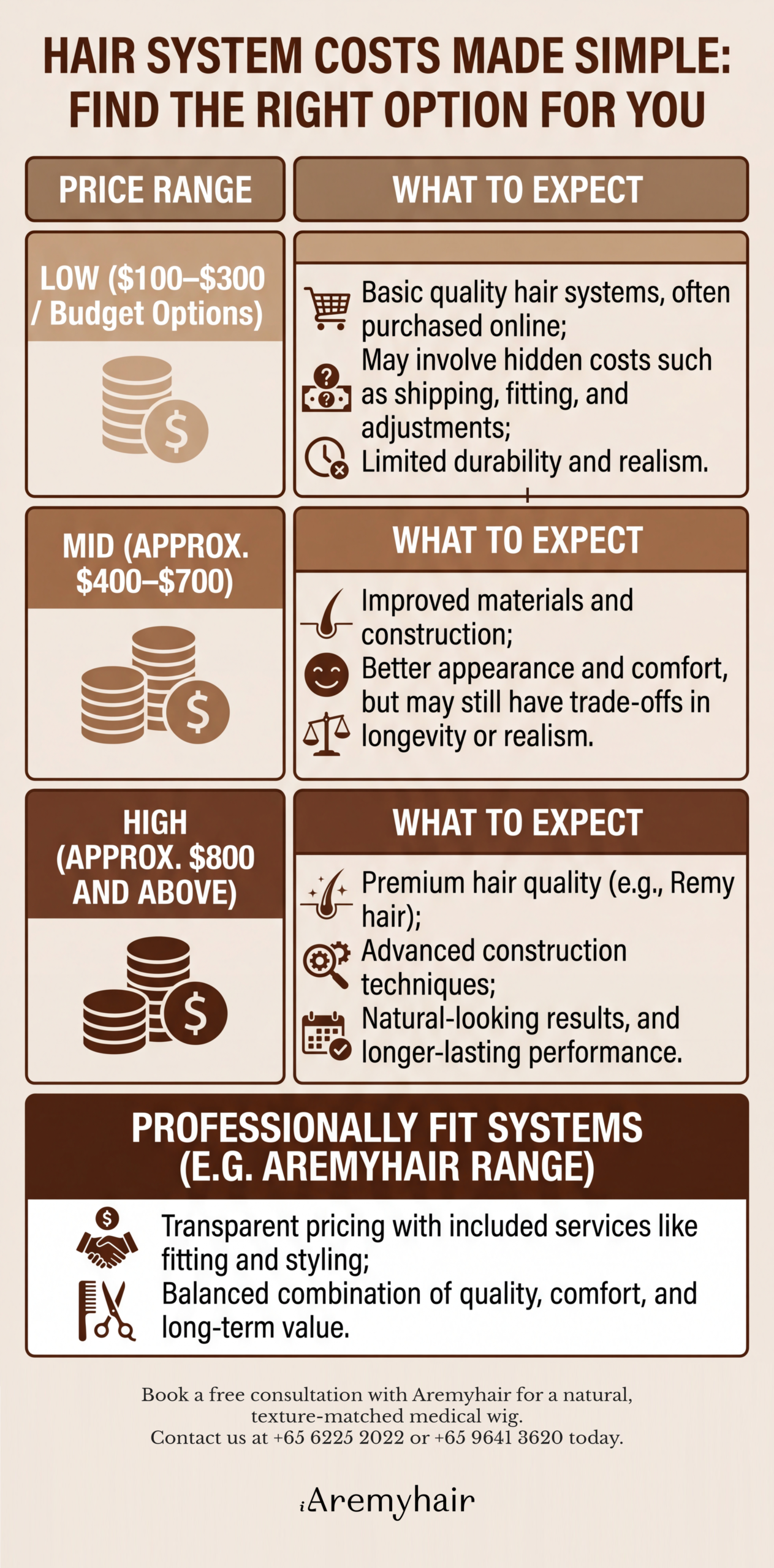
When buying a Hair Replacement System (HRS), the lowest price is almost never the best value. An $88 unit that looks fake, itches your scalp, and mats in weeks is simply time and money wasted. Conversely, the highest price doesn’t always guarantee consistent good quality; because every hair system is handmade, even premium units can be prone to minor defects.
It is easy to find cheap hair and sell it at a low price, but that is not our philosophy. We believe in providing only the best quality, comfort, and the most natural look for our clients. We pride ourselves on the fact that every client walks out of our salon feeling like a new person, able to go about their daily lives with total confidence, never worrying that their hair looks unnatural.
To ensure you are getting the value you deserve, educate yourself on the materials. Ask about the denier of the lace, the origin of the hair, and the type of knotting used. Understanding the making of the system is the only way to truly understand the value of what you are buying.
At Aremyhair, with over 20 years of experience in non-surgical hair replacement, our team of skilled specialists provides personalised consultations and professional fittings to help you achieve the most natural-looking results.
BOOK A FREE CONSULTATION WITH AREMYHAIR TODAY and discover a hair solution tailored to your style, comfort, and confidence.
FREQUENTLY ASKED QUESTIONS
A high-quality hair system can range widely depending on the materials, craftsmanship, and level of customisation. While lower-cost options exist, premium systems reflect the use of better hair quality, more durable construction, and skilled handwork—making them a worthwhile long-term investment.
Human hair typically feels soft and natural, with slight variations in texture and movement. It also responds to heat styling tools, unlike most synthetic fibres. In contrast, synthetic hair may feel slightly stiff and can appear overly shiny or uniform.
In most cases, yes. Higher-priced systems often use better-quality hair and more secure construction methods, such as double-knotting and hand-tied sections, which improve durability. However, proper maintenance also plays a key role in how long your system lasts.
Lace front and monofilament designs are considered among the most natural-looking options. They create a realistic hairline and scalp appearance, allowing for versatile styling and parting.
Buying in-store allows you to see, feel, and try on the hair system before purchasing, ensuring the right fit, colour, and comfort. It also gives you access to professional fitting and styling services, which can make a significant difference in achieving a natural look.