
Choosing a hair replacement system can quickly become confusing. Human hair or synthetic? Lace or another base? How thick should the hair be? And when a studio describes a system as “custom”, what exactly is being customised?
The answer matters because a natural-looking result depends on more than simply choosing attractive hair. A well-planned system needs to work with your head shape, remaining hair, preferred hairstyle and everyday routine.
For anyone considering custom hair replacement systems, it helps to understand two separate decisions: what the hair is made from, and how the system itself is designed for you.
HUMAN HAIR VS. SYNTHETIC HAIR: WHAT IS THE DIFFERENCE?
Human hair systems use real human hair, while synthetic systems use manufactured fibres designed to imitate natural hair.
Both can produce convincing results. The better option depends on how you want your hair to look, how often you plan to wear the system, your budget and how much maintenance you are comfortable with.
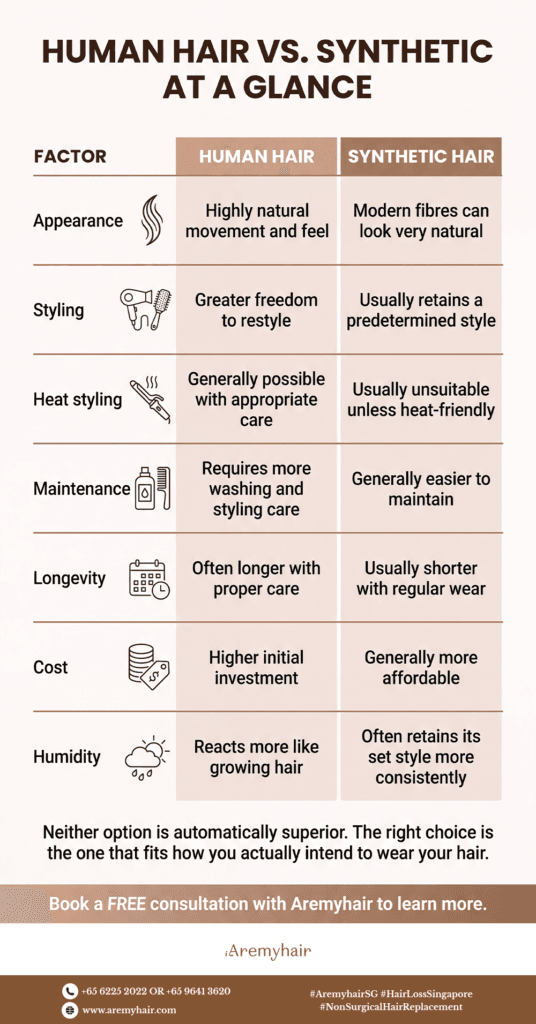
Synthetic wigs generally require less maintenance and cost less, while human hair wigs offer greater styling flexibility and often last longer when properly cared for.
LOOK AND MOVEMENT
One of the main reasons people choose human hair is its natural movement.
Good-quality human hair wigs and hair systems respond much like growing hair. They fall naturally, move with the wearer and can usually be restyled into different looks. High-quality Remy hair can also reduce tangling because its cuticles are kept aligned in the same direction.
Modern synthetic fibres have improved considerably and can also look very natural. However, depending on the fibre and construction, some synthetic hair may appear slightly shinier or move differently from human hair.
The base construction and fitting matter just as much. A carefully designed lace front, for example, can help create the appearance of hair emerging naturally around the front of the scalp.
STYLING FLEXIBILITY
If you regularly change your hairstyle, human hair offers greater freedom.
It can generally be washed and styled in much the same way as natural hair, although gentle products and careful handling remain important. Human hair also responds to weather and humidity, so it may need restyling after washing or during humid conditions.
Traditional synthetic fibres behave differently. Their shape is usually built into the fibre, so a washed synthetic piece can return to its original style after drying. This makes it convenient for someone who wants a consistent, ready-to-wear look with minimal daily styling.
Standard synthetic fibres should generally not be exposed to heated styling tools unless they are specifically labelled heat-resistant or heat-friendly.
LONGEVITY
There is no universal lifespan for a hair system. Frequency of wear, fibre quality, base construction, styling habits and maintenance can all affect how long it remains usable.
As a general comparison, human hair tends to last longer than conventional synthetic fibre when both are properly maintained. Human hair wigs may last a year or more depending on wear and care, while standard synthetic wigs commonly have a shorter useful lifespan.
COST
Synthetic hair normally has the lower initial cost.
For someone who wants a practical backup piece, a temporary solution or a fixed hairstyle without extensive upkeep, that can be a meaningful advantage.
Human hair usually costs more because of the material itself and the additional processing involved. The overall cost of a custom system can also vary depending on base construction, coverage area, hair length, density and other specifications.
Rather than looking only at the purchase price, consider how frequently you will wear the system, how much styling freedom you want and what ongoing maintenance you are prepared for.
WHAT DOES “CUSTOM” HAIR REPLACEMENT ACTUALLY MEAN?
The word “custom” should involve more than selecting a colour from a catalogue.
A genuinely customised system is planned around the individual wearing it. Custom systems can be produced from measurements or a scalp template, with greater control over dimensions, base construction, density, colour, grey percentage, curl and hair direction.
Three elements are especially important.
1. BASE SHAPE AND SIZE
The base is the foundation of the hair system.
During the fitting process, the area requiring coverage needs to be assessed so that the system follows the relevant contours of the scalp. A custom design can account for an individual hair-loss pattern rather than relying solely on a standard size.
Base material also affects comfort, breathability, durability and appearance. Lace constructions, for example, can provide ventilation, while other materials may be chosen where additional durability or particular attachment requirements are priorities.
This becomes especially relevant in a warm, humid climate, where airflow and perspiration can influence comfort and servicing needs.
2. DENSITY MAPPING
More hair does not automatically create a better result.
Density refers to how much hair is distributed through different areas of the system. If a system is considerably fuller than the wearer’s natural hair at the sides or back, the difference can make blending more difficult.
Customisation allows density to be planned around the wearer rather than kept identical throughout the piece. Hair replacement specialists can also refine density during fitting and blending.
3. HAIRLINE DESIGN
The front hairline is one of the most visible parts of any system, particularly for hairstyles that expose the forehead.
Its position, shape and density should suit the wearer’s face and existing hair pattern. Lace-front construction is commonly used to create a more realistic transition because the fine material can allow individual hairs to appear as though they are emerging from the scalp.
A custom fitting can therefore consider not only where the hairline begins, but also how it blends into the rest of the hairstyle
WHICH OPTION IS RIGHT FOR YOU?
Consider human hair if natural movement and styling versatility are high priorities and you are comfortable with more regular upkeep.
Synthetic hair may make more sense if you prefer a consistent style, lower initial cost and simpler everyday maintenance.
But fibre is only part of the decision. Someone wearing a beautifully made human hair system with the wrong density or poorly matched base may be less satisfied than someone wearing a carefully selected synthetic piece that suits their needs.
That is why consultation and fitting matter.
At Aremyhair, custom-made non-surgical hair replacement options can be planned around factors such as your coverage needs, head shape, desired density, colour and preferred style.
VISIT OUR STUDIO TO SEE THE AREMYHAIR DIFFERENCE and compare hair and base options in person before deciding.
FIND A HAIR SYSTEM THAT FITS YOUR LIFE, NOT JUST YOUR HEAD
The choice between human and synthetic hair comes down to priorities.
Human hair provides natural movement and greater styling flexibility, usually with a higher cost and more maintenance. Synthetic hair offers convenience, consistent styling and a lower starting price, although it generally provides less styling freedom and may need replacement sooner.
For a truly personalised result, however, look beyond the fibre itself. Base shape, density distribution, hairline design, colour, texture and professional fitting all contribute to how naturally the finished system blends into everyday life.
If you are comparing custom hair replacement systems or searching for a human hair wig in Singapore, BOOK AN APPOINTMENT WITH AREMYHAIR NOW to explore an option designed around your appearance, routine and preferences.
Contact +65 6225 2022 or +65 9641 3620 to arrange a private consultation.
Sources:
- National Alopecia Areata Foundation — Wigs and Toppers: Understanding the Basics
https://www.naaf.org/confidence-guide/wigs-and-toppers-understanding-the-basics/ - American Cancer Society — Wigs for Hair Loss
https://www.cancer.org/cancer/side-effects/hair-skin-nails/hair-loss/choosing-and-wearing-wig.html - Breastcancer.org — Synthetic vs Human Hair Wigs: Which Fiber Type Is Right for You?
https://www.breastcancer.org/treatment-side-effects/hair-loss/wigs/fiber-type-synthetic-vs-human - Macmillan Cancer Support — Coping With Hair Loss
https://www.macmillan.org.uk/dfsmedia/1a6f23537f7f4519bb0cf14c45b2a629/20117-10061/MAC11627_E10_coping%20with_hair%20loss_20250225 - American Hair Loss Association — Men’s Hair Pieces
https://www.americanhairloss.org/non-surgical-hair-replacement/mens-hair-pieces/