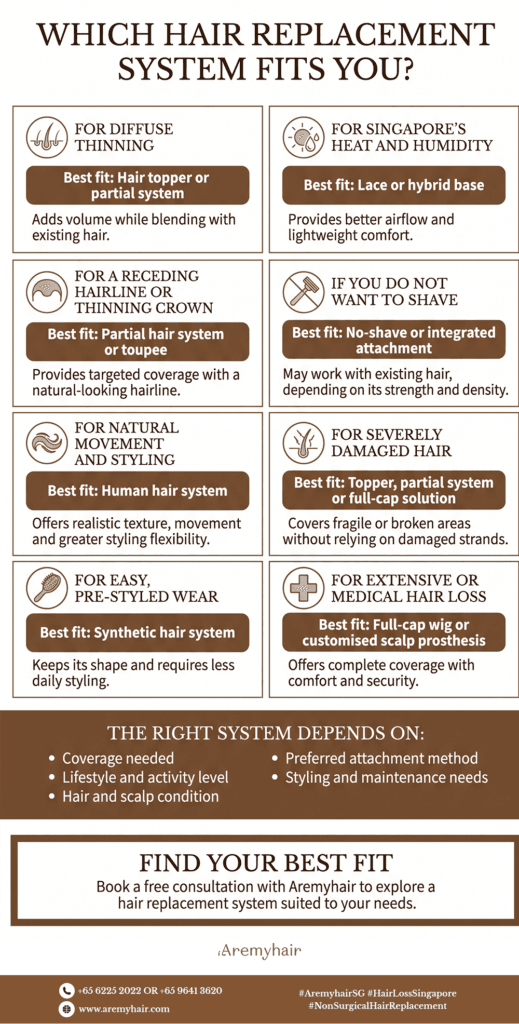
Choosing a hair replacement system is not simply a matter of picking a hairstyle from a catalogue. The right solution depends on where you are experiencing hair loss, how much existing hair you have, how active you are and how much time you want to spend on maintenance.
You may need targeted coverage for a thinning crown, greater density across the top of the scalp or a full-cap solution for extensive hair loss. You may also be deciding between human and synthetic hair, wondering whether your remaining hair must be shaved or looking for something comfortable in Singapore’s warm, humid climate.
Hairpieces and wigs can be used for temporary or permanent hair loss and offer an immediate cosmetic result while medical treatments may take considerably longer to show visible changes. This guide explains which type of hair replacement system may fit different situations, helping you approach your consultation with clearer expectations.
YOU ARE A WOMAN EXPERIENCING DIFFUSE THINNING
Female-pattern hair loss often develops differently from male-pattern baldness. Rather than forming a clearly defined bald patch, women may notice reduced density across the top of the scalp, a widening part or more visible scalp between existing strands. Female-pattern hair loss generally affects the anterior scalp and tends to be less defined than the typical male pattern.
A partial hair system or topper may be suitable when you still have healthy hair around the thinning area. Instead of covering the whole head, it adds volume where it is needed and blends into your existing length.
Important considerations include:
- A base that covers the thinning zone without adding unnecessary bulk
- A density that blends naturally with your remaining hair
- Flexible parting that allows you to maintain your preferred hairstyle
- A precise match for colour, texture and curl pattern
Monofilament and lace constructions are often considered for their realistic scalp appearance and styling flexibility. Women experiencing widespread or medically related hair loss may instead benefit from a fuller hairpiece or medical wig.
Learn more about hair replacement systems.
YOU ARE A MAN WITH A RECEDING HAIRLINE OR THINNING CROWN
Male-pattern hair loss commonly affects the temples, frontal hairline and crown. For this pattern, a partial hair system or toupee can provide coverage only where it is required while blending with the hair at the sides and back.
The most natural result depends on more than simply covering the bald area. The system’s hairline, density, direction and colour should all complement your age, facial features and existing hair.
A lace front may help create a less visible transition at the forehead, particularly for styles worn away from the face. A skin or polyurethane perimeter may offer a more straightforward attachment and cleaning process. Hybrid bases combine different materials to balance hairline realism, breathability and secure attachment.
A professional fitting also helps avoid choosing excessive density. A system that is much thicker than your remaining hair can be more noticeable than one designed to recreate a realistic, age-appropriate appearance.
Explore our beginner’s guide to choosing your first hair system.
YOU WANT THE MOST NATURAL MOVEMENT AND STYLING FREEDOM
Human hair is generally the preferred choice for people who prioritise realistic movement, softness and styling versatility. It can be cut and styled in ways similar to naturally growing hair, although heat should still be used carefully.
Remy human hair is arranged with the cuticles aligned in the same direction. This helps the strands remain smoother and reduces unnecessary tangling when the system is maintained correctly.
Human hair may fit your situation when you:
- Regularly change your hairstyle
- Want to use low-temperature styling tools
- Prefer natural movement and texture
- Need the system to blend with longer existing hair
- Are prepared to wash, condition and style it regularly
Some of the advantages of using human hair include a natural appearance and styling flexibility. However, it also requires more careful washing and conditioning.
YOU PREFER CONVENIENCE AND A PRE-STYLED LOOK
Synthetic hair may be more suitable when cost, shape retention and straightforward daily care are the priorities. Synthetic systems and wigs often arrive pre-styled and can return to their original shape after washing.
However, they generally offer less styling flexibility. Standard synthetic fibres may be damaged by high temperatures, and some can feel warmer or move less naturally than human hair.
A synthetic option may suit someone who:
- Wants a consistent, ready-to-wear style
- Prefers minimal day-to-day styling
- Needs a temporary or backup hairpiece
- Has a more limited initial budget
- Does not intend to colour or frequently restyle the hair
Neither material is automatically right for everyone. Your choice should reflect how you intend to wear, style and maintain the system rather than price alone.
Read more about human hair and synthetic wig options.
YOU ARE CONCERNED ABOUT SINGAPORE’S HEAT AND HUMIDITY
Warm weather, perspiration and frequent outdoor activity can affect how a hair system feels and how often it requires servicing. Breathability should therefore be a major consideration when selecting a hair replacement system in Singapore.
Lace bases allow more airflow than solid skin-style bases and may feel lighter during prolonged wear. Monofilament bases provide a balance of strength, realism and ventilation, while hybrid systems combine breathable sections with polyurethane areas that support attachment.
Your daily routine matters as much as the base itself. Someone who works in an air-conditioned office may have different maintenance needs from someone who exercises frequently, works outdoors or travels regularly.
Whatever you choose, consistent cleaning is essential. Oil, perspiration and product residue can accumulate on both the scalp and base. Professional servicing can help keep the attachment secure and the system comfortable.
YOU DO NOT WANT TO SHAVE YOUR EXISTING HAIR
Many first-time users hesitate because they assume their remaining hair must be removed. In practice, shaving requirements depend on the attachment method, coverage area and condition of the existing hair.
Some systems can be attached around or integrated with remaining hair. Clips may be an option for removable pieces when there is enough strong hair to support them. Bonding tapes or adhesives may be applied to selected scalp areas rather than requiring the entire head to be shaved.
However, retaining hair beneath or around a semi-permanent system can make cleaning and attachment more complex. Weak or sparse hair may also be unsuitable for clip-based methods because repeated tension could contribute to breakage.
The best approach is to have a specialist assess:
- The strength and density of your existing hair
- The location and progression of your hair loss
- Your preferred attachment security
- How frequently you want to remove the system
- Your scalp sensitivity and maintenance routine
Avoiding shaving may be possible, but the final method should prioritise scalp health, comfort and a dependable fit.
YOUR NATURAL HAIR IS SEVERELY DAMAGED
Hair can become fragile through repeated bleaching, chemical straightening, excessive heat or tight hairstyles.
When damaged strands can no longer provide the appearance or density you want, a hair system may offer immediate cosmetic coverage while you adopt gentler care practices for the remaining hair.
The appropriate option depends on the extent of damage. A topper may conceal breakage around the crown, while a larger partial or full-cap system can provide more comprehensive coverage. Attachment methods should avoid placing unnecessary tension on already weakened strands.
Hair damage can sometimes occur alongside an underlying scalp condition or form of alopecia. Sudden shedding, soreness, scaling or unexplained bald patches should be assessed by a healthcare professional before fitting a system. A hairpiece can improve appearance, but it does not diagnose or treat the cause of hair loss.
YOU HAVE EXTENSIVE OR MEDICALLY RELATED HAIR LOSS
For alopecia areata, chemotherapy-related hair loss or extensive thinning, a full-cap wig or customised scalp prosthesis may provide the necessary coverage.
Comfort is especially important when the scalp is sensitive. Look for:
- Soft materials that minimise friction
- A lightweight and breathable cap
- A secure but non-restrictive fit
- Adjustable features where appropriate
- A natural density and hairline
- Manageable care requirements during treatment or recovery
One may also consider choosing a wig before treatment-related hair loss begins, when it may be easier to match the person’s existing colour and style.
For medically related hair loss, personal comfort and ease of care may matter more than elaborate styling. A private consultation can help you compare full-cap human hair, synthetic and medical wig options without pressure.
Read our guide to choosing a medical wig.
HOW TO MAKE YOUR FINAL CHOICE
The best hair replacement system is the one designed around your actual situation—not simply the most expensive or most heavily advertised option.
Before deciding, consider these questions:
- Do you need partial or full coverage?
- Is your hair loss localised, diffuse or progressing?
- Do you prefer styling versatility or low maintenance?
- How active are you, and how often do you perspire?
- Do you want removable or longer-wear attachment?
- How much existing hair do you wish to retain?
- What level of professional aftercare can you commit to?
At Aremyhair, each consultation considers your hair-loss pattern, lifestyle, desired appearance and comfort needs. Your system can then be selected and customised for its base, coverage, density, texture, colour and attachment method.
There is no single system that suits every man or woman. The value of professional guidance lies in finding the combination that works naturally with your scalp, existing hair and daily life.
BOOK AN APPOINTMENT WITH AREMYHAIR NOW and discover which hair replacement system fits your situation. Contact +65 6225 2022 or +65 9641 3620 to arrange a private consultation.
Sources:
- DermNet — Hairpieces and Wigs
https://dermnetnz.org/topics/hair-pieces-and-wigs - DermNet — Hair Loss, Balding, Hair Shedding and Alopecia
https://dermnetnz.org/topics/hair-loss - American Academy of Dermatology — Alopecia Areata: Diagnosis and Treatment
https://www.aad.org/public/diseases/hair-loss/types/alopecia/treatment - American Cancer Society — Choosing and Wearing a Wig
https://www.cancer.org/cancer/side-effects/hair-skin-nails/hair-loss/choosing-and-wearing-wig.html - American Academy of Dermatology — Tips for Healthy Hair
https://www.aad.org/public/everyday-care/hair-scalp-care/hair/healthy-hair-tips