
Hair thinning in women can be gradual and surprisingly difficult to describe. You might notice that your parting looks wider, your ponytail feels smaller or your scalp is becoming more visible under bright light. Yet there may be no single bald patch or dramatically receding hairline.
This is one reason why female hair replacement systems should not simply be treated as smaller versions of men’s hairpieces. Women often experience a different pattern of hair loss, requiring careful decisions about coverage, base construction, hair density and styling.
A well-designed system should do more than cover the scalp. It should work with the hair you still have, match the way you normally part and style it, and feel manageable within your everyday haircare routine.
WHY WOMEN’S HAIR LOSS OFTEN NEEDS A DIFFERENT APPROACH
In female pattern hair loss, thinning commonly occurs across the top or central part of the scalp while the frontal hairline remains relatively preserved. The part may gradually widen, and individual strands in the affected areas may become finer and shorter.
This differs from the more recognisable pattern frequently seen in men, where hair loss may begin with a receding hairline, thinning temples or a distinct bald area at the crown.
Women may also experience shedding from telogen effluvium, alopecia areata, hormonal changes, nutritional deficiencies, certain medicines or underlying medical conditions. Some causes are temporary, while others require medical assessment and ongoing management.
A hair replacement system does not diagnose or treat the underlying cause. Sudden, unexplained or rapidly progressing hair loss should therefore be assessed by a doctor or dermatologist. However, for women seeking an immediate cosmetic solution, non surgical hair replacement can restore visible coverage without waiting for possible regrowth.
COVERAGE IS DESIGNED AROUND DIFFUSE THINNING
A men’s hair system commonly targets a relatively defined area, such as the front, temples or crown. Women may need broader yet more selective coverage because their natural hair is often still present throughout the thinning area.
Depending on the pattern and severity of hair loss, possible options include:
- Hair toppers, which sit over the top or crown and blend with the wearer’s natural lengths
- Partial systems, designed for a particular area of reduced density
- Larger integration systems, which provide broader coverage while incorporating existing hair
- Full wigs, which may be more suitable when hair loss affects most or all of the scalp
The goal is not necessarily to cover the entire head. It is to identify where additional volume is needed and create a system that integrates naturally with the surrounding hair.
A professional assessment should consider the size and location of the thinning area, the strength of the remaining hair, the wearer’s preferred parting and how the pattern may change over time.
BASE CONSTRUCTION AFFECTS COMFORT AND INTEGRATION
The base is the foundation onto which the replacement hair is attached. For women, its design may need to accommodate longer hair, wider coverage and natural hair growing beneath or around the system.
LACE BASES
Lace is valued for being lightweight and breathable. Its fine mesh construction can create a natural-looking finish, particularly around exposed partings and hairlines.
Breathability can be especially useful in warm, humid environments. However, finer lace may require gentler handling and careful maintenance.
MONOFILAMENT BASES
Monofilament is a mesh material that is durable and can take the weight of more hair, but is rough to the touch. It is usually sandwiched in between two layers of hair. Its fine, silk-like cloth makes monofilament comfortable to wear and also creates the appearance of hair emerging from the scalp. Individual hairs may be attached in ways that allow more flexibility when changing the part.
This makes monofilament useful for women who want styling versatility and a realistic-looking crown, although the material may feel slightly more substantial than delicate lace.
POLY OR SKIN BASES
Polyurethane bases offer a smooth surface and can allow secure attachment and straightforward cleaning. Thin versions may imitate the appearance of the scalp, but poly is generally considered not breathable as compared to lace.
HYBRID BASES
Hybrid systems combine different materials. For example, a system may use breathable lace through the centre with a poly perimeter for easier attachment.
There is no single “best” base. The appropriate choice depends on comfort, scalp sensitivity, preferred attachment method, lifestyle and the balance between realism and durability.
Aremyhair’s previous beginner’s guide similarly highlights lace, poly, monofilament and hybrid constructions as options with different levels of breathability, realism and durability.
HAIR DENSITY MUST LOOK BELIEVABLE
More hair does not automatically produce a more natural result.
One of the most important differences in designing female hair replacement systems is selecting the correct density. A system that is much thicker than the wearer’s remaining hair may create an obvious contrast at the sides or back.
Instead, density should be customised according to factors such as:
- the client’s natural hair thickness;
- the density of the surrounding hair;
- age and facial proportions;
- the length and style requested; and
- whether the objective is subtle volume or fuller coverage.
Density may also vary across one system. A lighter, graduated density near the hairline or part can create a softer transition, while slightly greater density through the crown may provide the volume the wearer wants.
Natural-looking results are usually achieved through balance—not maximum thickness.
THE PARTING AND HAIR DIRECTION MATTER
Many women have worn their hair in the same parting for years. They may also have a recognisable fringe, layers or preferred direction of movement.
A women’s hair system should therefore be planned around how the hair will fall when styled. The placement of individual strands, the direction of ventilation and the structure of the base influence whether the finished hair can be parted, swept back or styled around the face.
Human hair systems generally offer greater styling flexibility because they can be washed, shaped and carefully heat-styled much like natural hair. Remy human hair, in which the cuticles are kept aligned, is often chosen to help reduce tangling and preserve a smoother finish.
At Aremyhair, systems can be personalised to complement the wearer’s existing colour, texture, density and preferred hairstyle. BOOK A FREE CONSULTATION WITH AREMYHAIR TODAY to discuss which construction and coverage may suit you.
CAN PEOPLE TELL THAT YOU ARE WEARING ONE?
Concern about detection is completely understandable. Many women worry that the edge will show, the part will look artificial or the system will shift during daily activities.
A natural result depends less on one particular material and more on how well all the details work together. These include:
- accurate measurements;
- appropriate coverage;
- a realistic density;
- a suitable base colour;
- careful colour and texture matching;
- a natural parting;
- secure attachment; and
- professional cutting and blending.
The system also needs to be reviewed as the wearer’s natural hair changes. A good result at the first fitting should be supported by ongoing adjustments and maintenance.
Modern hair replacement should not create a helmet-like layer of uniform hair. It should replicate the subtle variations found in natural hair and move cohesively with the wearer’s own strands.
WILL A HAIR SYSTEM COMPLICATE YOUR HAIRCARE ROUTINE?
There is an adjustment period, but caring for a hair system does not need to take over your life.
The exact routine depends on the base, attachment method, hair length and activity level. General care may include:
- washing at the frequency recommended by your stylist;
- using gentle, suitable shampoo and conditioner;
- detangling carefully from the ends upwards;
- avoiding aggressive rubbing or pulling;
- using moderate heat when styling human hair;
- protecting longer hair from friction while sleeping; and
- attending scheduled maintenance appointments.
Longer female hairstyles may need more conditioning and detangling than short men’s systems. Hair attached to a system also does not receive natural oils from the scalp in the same way growing hair does, so moisture care is important.
Professional maintenance may involve cleaning the base, removing and renewing the attachment, washing the scalp, checking the fit and restyling the hair. Aremyhair generally recommends maintenance according to the individual system and wearer rather than treating every client’s routine as identical.
VISIT THE AREMYHAIR STUDIO TO SEE THE DIFFERENCE BETWEEN BASE MATERIALS, HAIR DENSITIES AND STYLING OPTIONS IN PERSON.
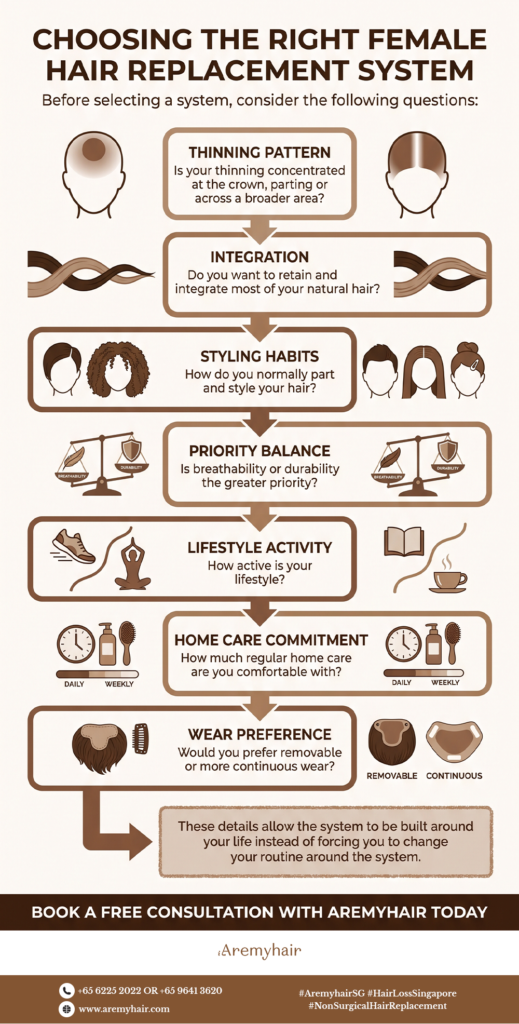
CHOOSING THE RIGHT FEMALE HAIR REPLACEMENT SYSTEM
Before selecting a system, consider the following questions:
- Is your thinning concentrated at the crown, parting or across a broader area?
- Do you want to retain and integrate most of your natural hair?
- How do you normally part and style your hair?
- Is breathability or durability the greater priority?
- How active is your lifestyle?
- How much regular home care are you comfortable with?
- Would you prefer removable or more continuous wear?
These details allow the system to be built around your life instead of forcing you to change your routine around the system.
A PERSONALISED SOLUTION FOR WOMEN’S HAIR LOSS
Women’s hair loss is not simply a cosmetic concern. Research has associated female pattern hair loss with psychological distress and effects on social functioning, which helps explain why choosing a replacement solution can feel so personal.
The right hair system should provide coverage without overwhelming your features, complement the hair you still have and give you the freedom to style it in a way that feels familiar.
Aremyhair offers personalised non surgical hair replacement for women, with attention to base construction, density, colour, texture, fit and aftercare. From discreet crown coverage to a more complete change, each solution begins with understanding your needs rather than selecting a generic product.
BOOK AN APPOINTMENT WITH AREMYHAIR NOW to explore female hair replacement systems designed around your hair, lifestyle and preferred look. Contact +65 6225 2022 or +65 9641 3620 to arrange a private consultation.
Sources:
- American Academy of Dermatology Association. Could It Be Female Pattern Hair Loss?
- British Association of Dermatologists. Female Pattern Hair Loss (Androgenetic Alopecia).
- National Center for Biotechnology Information. Androgenetic Alopecia — StatPearls.
- Fabbrocini G, et al. Female Pattern Hair Loss: A Clinical, Pathophysiologic, and Therapeutic Review.
- NHS. Hair Loss: Causes, Assessment and Available Treatments.